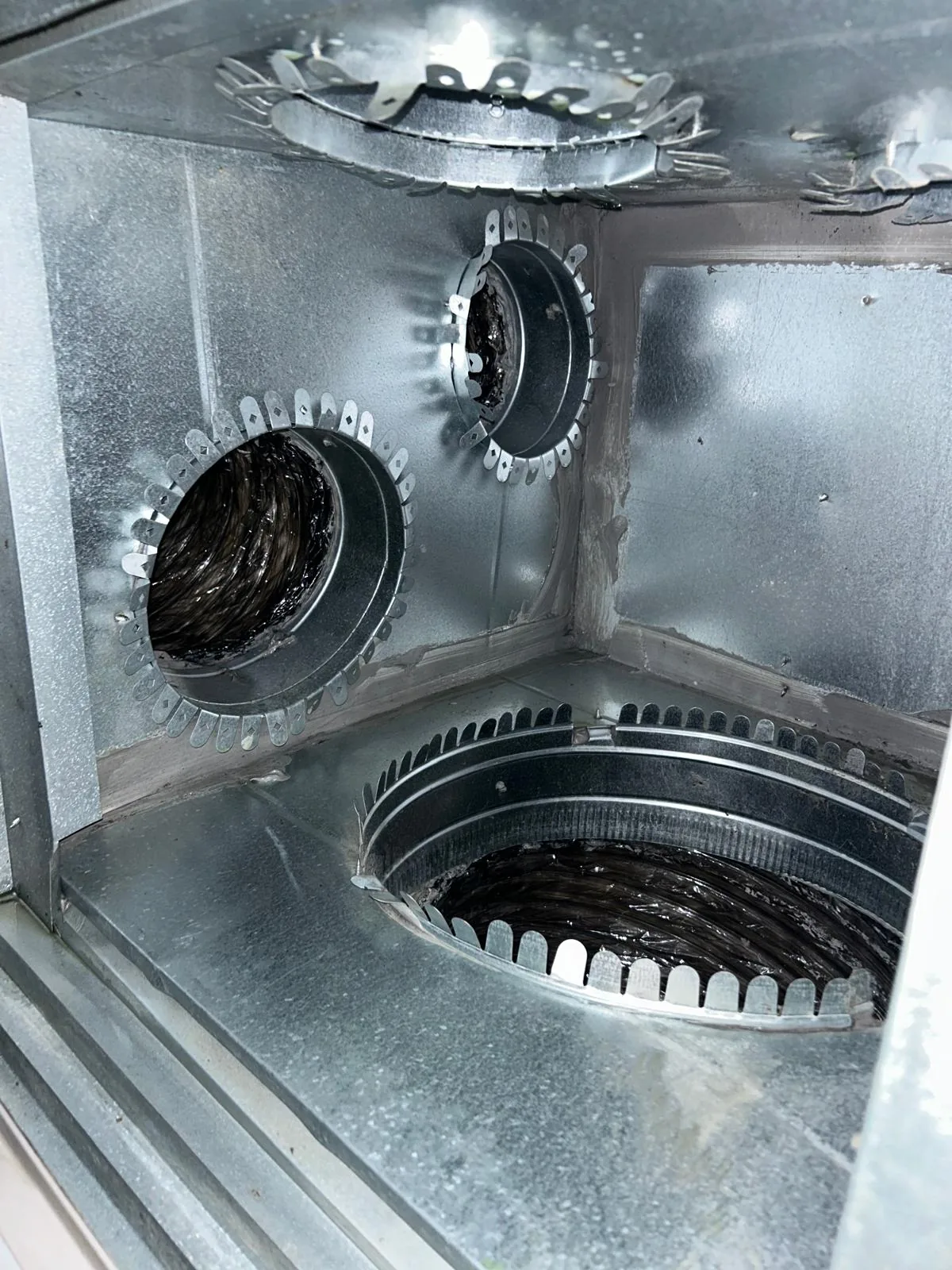
Asthma, Allergies, Infants and Older Adults: What Ducts Can and Can't Do
The households that ask us this question hardest deserve the most careful answer. Here is what the evidence supports, what it doesn't, and the changes that actually move indoor air for a sensitive household.
If someone in your house has asthma, bad seasonal allergies, a new baby, or is older and spends most of the day indoors, you have probably been told that dirty ducts are the reason. Sometimes a duct system genuinely is part of the problem. Far more often it isn't, and the money would do more good somewhere else in the same system. We would rather tell you which one you're looking at than sell you the cleaning either way.
01Start with what the EPA actually says
The EPA's position on residential duct cleaning is short and it has not changed: duct cleaning has never been shown to actually prevent health problems, and studies do not conclusively demonstrate that particle levels in homes rise because of dirty ducts. That is the honest starting line, and any company that skips past it is selling you something.
What the EPA does say is that you should consider having your ducts cleaned when one of three specific things is true. There is substantial visible mold growth inside the hard surfaces or on other components of the system. The ducts are infested with vermin — rodents or insects. Or the ducts are so clogged with dust and debris that particles are actually being released into the room through the registers.
Notice what those three have in common. Each one is something a camera can see. None of them is a symptom you feel. That is why we start every visit with footage rather than a quote: the question 'do my ducts need cleaning' has a visual answer, and yours is the only system that matters.
02If someone in the house has asthma
Asthma is triggered by things that are mostly not resolved by cleaning a duct: dust mites in bedding and upholstery, pet dander on soft surfaces, cockroach allergen, tobacco smoke, fragrance, and humidity swings. Source control — removing or reducing the thing itself — is the intervention with the strongest support behind it, and almost all of it happens in rooms rather than in ductwork.
There are two places where the duct system genuinely enters the picture. The first is filtration. A filter that is too thin, too dirty, or too restrictive for the blower it sits in front of will let fine particulate straight past it or choke airflow so badly that the system barely moves air at all. Matching the filter to what your blower can actually pull is a real, measurable improvement, and it is cheap.
The second is leakage. Return ducts that run through an attic or a crawlspace and have open seams do not pull air from your rooms — they pull it from the attic. That is insulation fibre, dust and whatever else lives up there, delivered to every room in the house on every cycle. Sealing that is not a comfort upgrade for an asthmatic household. It is the actual problem.
What we will not tell you is that cleaning your ducts will reduce anyone's symptoms. We don't know that, the evidence doesn't establish it, and your doctor is a better guide to managing asthma than any duct company.
03If it's seasonal allergies in North Texas
Dallas–Fort Worth has one of the longer allergy calendars in the country and very little of it involves your ductwork. Mountain cedar runs through the winter months and is the one that catches newcomers off guard. Oak and ash arrive in early spring and coat everything in yellow. Bermuda grass carries the early summer. Ragweed takes over from late summer into autumn.
None of that is generated inside your ducts. It comes in through open doors, on clothing, on pets, and through gaps in the building envelope, and then it circulates. Which means the useful lever during allergy season is not cleaning the ducts — it is capturing more of what is already in the air, more often.
In practice that means a filter with a MERV rating your blower can tolerate, changed on a real schedule rather than when you remember, plus running the fan more during peak weeks so the air passes the filter more times per hour. If your system has only one small return, adding a second return path is often the single biggest improvement available, because a starved system cannot filter air it never gets to move.
04A new baby, or a renovation, or both
This is the case where duct work most often is the right call, and the reason has nothing to do with the baby's lungs. It is that construction happened.
Drywall dust, sawdust and jobsite debris are fine, abundant, and they end up in the return side of the system where a filter never gets a chance at them. A remodel with the system running — which is most remodels — loads the ductwork in a way that ordinary living never does. If you have just finished work on the house, a camera inspection will usually show you something worth acting on, and the after-photos will show the difference plainly.
The rest of what matters for an infant is not duct-related and we would rather say so: keep relative humidity in a sane band, keep the nursery free of fragrance and aerosols, and do not put an ozone-generating air cleaner anywhere near the room. The EPA is unambiguous that ozone generators sold as air cleaners are not effective at safe concentrations, and ozone is a respiratory irritant. If we install an air cleaner for you it is a zero-ozone validated unit, and we will say no to the other kind.
05Older adults, and anyone who spends the day indoors
Someone home twenty-four hours a day breathes their indoor air far more than the rest of the household does, so the small things compound. But the complaint we are most often called about in these homes is not particulate — it is that one room never gets comfortable, or the system runs constantly and still doesn't hold temperature.
That is usually a duct problem in the mechanical sense: a crushed flex run, a disconnected boot dumping conditioned air into an attic, a return that is undersized for the equipment. Those are worth fixing on their own terms. They also happen to be the failures that pull unconditioned attic air into the living space, which is the version of a duct issue that genuinely affects what someone breathes.
For a household where someone is recovering from illness or is immunocompromised, the honest advice is the same as for asthma, in the same order: control the source, filter what you can, seal what leaks, and treat the duct interior only if a camera gives you a reason.
06The one duct condition that is a real health matter
Visible mold growth on a wet surface inside the system is different from dust, and we treat it differently. It is the first of the EPA's three conditions for a reason.
Two things follow from finding it. First, growth is a moisture problem before it is a cleaning problem — something is wet that should be dry, and unless that source is found it comes back regardless of what anyone sprays. Second, the material matters. On hard metal, growth can be physically cleaned. On porous liner or fibreglass duct board, the EPA's guidance is that it cannot be cleaned effectively, and replacement of the affected section is the honest answer rather than a treatment applied over the top.
We test and document. Remediation itself goes to a licensed remediator — we do not do that work ourselves, which also means we have nothing to gain by telling you that you need it.
07What we recommend most often instead of a cleaning
Across sensitive households, three things come up far more often than duct cleaning does, and all three cost less.
Match the filter to the blower. The highest MERV number on the shelf is frequently the wrong answer — a filter too restrictive for your equipment reduces airflow, which reduces how much air gets filtered at all, and can ice a coil. There is a right number for your system and it is knowable.
Fix the return path. Most homes in this metro were built with one undersized return. Adding a path, or fitting a filter-back return grille, changes how much air the system can actually process.
Seal what leaks. Sealed ducts stop importing attic air, hold conditioned air where you paid to put it, and are the closest thing to a genuine indoor-air improvement that duct work offers.
If you are asking this question because of someone specific in your house, the most useful thing we can do is look and tell you the truth — including the frequent answer that your ducts are fine and your filter, your return, or your humidity is where the problem lives. The camera inspection produces that verdict either way, and you keep the footage regardless of what you decide to do next.
Every recommendation in this guide starts from one place: a graded, photographed inspection. Book a system assessment and pair it with a filtration upgrade consultation — one standard, one paper trail, every job.